A magia do tempo... / The magic of time..
- luaemp
- 5 de out. de 2025
- 9 min de leitura
(Followed by the English version)

(Imagem Retirada de Meisterdrucke)
Ah, meus amigos, inicio o post de hoje com uma confissão, para muitos, talvez perturbadora: sou uma fã incondicional do Peter Pan… Creio que nunca vi nenhum outro filme tantas vezes como este… E acreditem, não é pela ideia de juventude eterna — pelo menos não da física — mas pela magia, literalmente, no ar e, porque não dizê-lo, pela eterna juventude que deveríamos todos manter no nosso espírito, essa curiosidade inerente, a capacidade de acreditar mesmo naquilo que parece ser impossível…
A primeira aparição do Peter Pan foi em 1902, no livro The Little White Bird de J. M. Barrie.


(Imagens retiradas de Ulysses Rare Books)
Depois, em 1904, o personagem ganhou vida própria na peça de teatro Peter Pan; or, the Boy Who Wouldn’t Grow Up.
Mais tarde, em 1911, Barrie adaptou a peça para romance, publicado como Peter Pan: The Story of Peter and Wendy.


(Imagens retiradas de Gary's Vintage Books)
A adaptação da Disney chegou bem mais tarde: o filme de animação “Peter Pan” estreou em 1953. A Disney tornou algumas cenas mais leves (o livro e a peça têm momentos um tanto sombrios) e fixou imagens que até hoje moldam o imaginário colectivo — como a Fada Sininho cintilante e ciumenta, a figura caricatural do Capitão Gancho e seus piratas ou a própria Terra do Nunca cheia de cores e aventuras.
E porque estas histórias parecem sempre querer conversar umas com as outras, não há como não saltar da Terra do Nunca para a Tír na nÓg, onde em vez de pó de fada basta atravessar o mar para se escapar ao envelhecimento.
Ora, quando andei a estudar para o post sobre esse herói irlandês chamado Fionn mac Cumhaill, tropecei na mítica Tír na nÓg, a “Terra da Eterna Juventude”, que habita o imaginário celta como um lugar além-mar, onde o tempo não corre da mesma forma, onde não existe doença nem morte, apenas abundância, beleza e juventude sem fim. Na altura, limitei-me a tirar algumas notas, deixando-as marinar até virem a lume… Para ser sincera, pouco me importa se J. M. Barrie, escocês de gema, se tenha inspirado ou não na Tír na nÓg, conceito celta com raízes profundas na mitologia irlandesa, ou na sua versão escocesa, a Tìr nan Òg.
Embora a principal diferença entre a Tír na nÓg e a Terra do Nunca de Peter Pan esteja no foco: a primeira é o Outro Mundo, ligado à espiritualidade, à morte e ao eterno; a segunda volta-se para a recusa em crescer, para a liberdade e criatividade que tantas vezes se perdem com as responsabilidades adultas.
Mas podemos encontrar pontos comuns: ambos são lugares fora do tempo comum, onde se escapa ao envelhecimento/crescimento; representam a ideia de juventude eterna; são acessíveis através de uma travessia mágica — viagem marítima no caso de Tír na nÓg, voo ou imaginação no caso da Terra do Nunca — e têm ligação a seres mágicos — o povo do Sídhe, habitantes do Outro Mundo Celta, tantas vezes confundido com fadas, mas que na tradição original está muito mais próximo de divindades ou espíritos; e as próprias fadas no universo de Peter Pan. Tudo isto me ficou a fervilhar nos parcos neurónios que ainda tenho em funcionamento…
Mas afinal porquê este longo preâmbulo? Pois bem, entremos então, sem mais delongas, no que me trouxe a estas considerações. O nosso amigo Fionn mac Cumhaill, ao que dizem, teve um filho: Oisín.
Oisín, não era propriamente um rapaz comum, herdara do pai coragem e habilidade no combate e, como era tradição entre os Fianna, aprendera também poesia e música, mantendo viva a tradição oral e as histórias heroicas do seu povo, mas ainda assim humano, sujeito ao tempo como todos nós.
Diz-se que, durante uma caçada com os Fianna, conheceu Niamh Cinn Óir, cujo nome significa 'Niamh dos Cabelos Dourados', uma mulher de beleza deslumbrante, que vivia em Tír na nÓg, a Terra da Eterna Juventude. Niamh é descrita em algumas versões como princesa deste reino encantado; noutras, surge como figura semidivina, filha de Manannán mac Lir ou ligada aos Tuatha Dé Danann, o panteão de deuses e seres mágicos da mitologia celta. Em todas as versões, a sua aparência sobrenatural e juventude eterna reforçam a ligação mágica aos vários Outros Mundos, reinos onde a magia e o tempo funcionam de forma diferente. Foi nesse encontro, algures na Irlanda, que eles se conheceram e que Niamh convidou Oisín a acompanhá-la até Tír na nÓg.
Curioso e encantado, Oisín aceitou e juntos atravessaram o mar. Chegados a Tír na nÓg, ele descobriu um mundo onde o tempo não corria como no mundo humano: os anos passavam, mas a juventude permanecia intacta. Para Oisín, três anos em Tír na nÓg pareciam apenas três dias. Para Niamh, isso era natural: sendo habitante do Outro Mundo, ela não envelhecia, fosse em terra humana ou em Tír na nÓg, permanecendo sempre jovem e imutável.
Algum tempo depois — uns dizem que foram 300 anos que em Tír na nÓg seriam três — Oisín, movido pela saudade da Irlanda, pediu a Niamh para visitar a sua terra natal. Ela advertiu-o: “Se tocares o solo humano, envelhecerás instantaneamente.” Ainda assim, ele partiu, atravessando o mar no corcel de Niamh. Ao chegar à Irlanda, tudo estava irreconhecível: a paisagem transformada, os amigos e familiares já desaparecidos… tudo tinha mudado.
Ao tentar ajudar alguns homens a mover uma pedra, caiu do cavalo e tocou o solo — e foi nesse instante que o tempo, que até ali ficara suspenso, se revelou: Oisín envelheceu de imediato, morrendo pouco depois. Algumas versões contam que, já nesse estado frágil, chegou a conversar com S. Patrício, partilhando memórias da vida dos Fianna — das caçadas, dos banquetes, da coragem do seu povo. São passagens breves, mas carregadas de simbolismo: Oisín é o último elo vivo com a Irlanda pagã e heroica, enquanto Patrício representa a nova era cristã.

(Imagem retirada de PJ Lynch: Oisin and St. Patrick)
E assim ficou para sempre esta história — metáfora da distância entre o humano e o mítico, do desejo de permanecer jovem e da inevitabilidade do tempo, que nem mesmo as terras encantadas conseguem deter. Oisín regressou e encontrou transformação e silêncio, porque o tempo dos homens não espera; nem heróis nem amantes são poupados à sua marcha.
Peter Pan, pelo contrário, sobrevive enquanto símbolo: não porque vença o tempo físico, mas porque encarna a recusa em deixar envelhecer a alma. Entre o herói celta e o menino voador abre-se um espelho que nos interpela — o primeiro mostra-nos que o corpo é frágil e naufraga à passagem do tempo, o segundo recorda-nos que o espírito pode suspender a gravidade, voar e resistir onde o corpo falha. Não há, portanto, verdadeira eternidade fora dos contos: há sim a escolha de como habitamos o tempo que nos cabe, se o vivemos apenas como sucessão de dias ou se ousamos prolongar nele a centelha do encantamento. Talvez aí resida a única juventude possível: não a que desafia a morte, mas a que se renova sempre que nos permitimos acreditar.
E, claro… algum pó de fada…
English Version
Ah, my friends, I begin today’s post with a confession, one that might be unsettling to many: I am an unconditional fan of Peter Pan… I believe I have never watched any other film as many times as this one… And believe me, it’s not for the idea of eternal youth — at least not in the physical sense — but for the magic, literally, in the air and, why not say it, for the eternal youth we should all keep in our spirit, that inherent curiosity, the ability to believe even in what seems impossible…
Peter Pan made his first appearance in 1902, in the book The Little White Bird by J. M. Barrie.


(Images taken from Ulysses Rare Books)
Then, in 1904, the character came to life in the play Peter Pan; or, the Boy Who Wouldn’t Grow Up. Later, in 1911, Barrie adapted the play into a novel, published as Peter Pan: The Story of Peter and Wendy.


(Imagens retiradas de Gary's Vintage Books)
The Disney adaptation arrived much later: the animated film Peter Pan premiered in 1953. Disney made some scenes lighter (the book and the play have somewhat darker moments) and created images that still shape the collective imagination today — like the sparkling, jealous Tinker Bell, the caricatured figure of Captain Hook and his pirates, and Neverland itself, full of colour and adventure.
And because these stories always seem to want to talk to each other, one can’t help but jump from Neverland to Tír na nÓg, where, instead of fairy dust, you only need to cross the sea to escape aging.
Well, when I was researching for the post about that Irish hero called Fionn mac Cumhaill, I stumbled upon the mythical Tír na nÓg, the “Land of Eternal Youth,” which inhabits the Celtic imagination as a place beyond the sea, where time does not run the same way, where there is no illness or death, only abundance, beauty, and endless youth. At the time, I merely took a few notes, letting them marinate until they came to light… To be honest, I care little whether J. M. Barrie, a true Scotsman, was inspired or not by Tír na nÓg, a Celtic concept with deep roots in Irish mythology, or by its Scottish version, Tìr nan Òg.
Although the main difference between Tír na nÓg and Peter Pan’s Neverland lies in their focus — the former is the Otherworld, connected to spirituality, death, and the eternal; the latter revolves around the refusal to grow up, the freedom and creativity that are so often lost with adult responsibilities — we can still find common points: both are places outside ordinary time, where one escapes aging or growing up; both represent the idea of eternal youth; both are accessible through a magical journey — a sea voyage in the case of Tír na nÓg, flight or imagination in the case of Neverland — and both are linked to magical beings: the people of the Sídhe, inhabitants of the Celtic Otherworld, often mistaken for fairies but in the original tradition closer to deities or spirits; and the fairies themselves in Peter Pan’s universe. All of this got my few remaining neurons buzzing…
But why this long preamble, you ask? Well, let us, without further ado, dive into what brought me to these reflections. Our friend Fionn mac Cumhaill, so they say, had a son: Oisín.
Oisín was not exactly an ordinary boy; he had inherited courage and skill in combat from his father and, as was the tradition among the Fianna, had also learned poetry and music, keeping alive the oral tradition and heroic stories of his people. Yet he was still human, subject to time like the rest of us.
It is said that, during a hunt with the Fianna, he met Niamh Cinn Óir, whose name means “Niamh of the Golden Hair,” a woman of breathtaking beauty who lived in Tír na nÓg, the Land of Eternal Youth. In some versions, Niamh is described as a princess of this enchanted realm; in others, she appears as a semi-divine figure, daughter of Manannán mac Lir or connected to the Tuatha Dé Danann, the pantheon of gods and magical beings in Celtic mythology. In all versions, her supernatural appearance and eternal youth emphasize the magical connection to the various Otherworlds, realms where magic and time operate differently. It was during this encounter, somewhere in Ireland, that they met and Niamh invited Oisín to accompany her to Tír na nÓg.
Curious and enchanted, Oisín agreed, and together they crossed the sea. Upon arriving in Tír na nÓg, he discovered a world where time did not flow as it did in the human world: the years passed, but youth remained intact. For Oisín, three years in Tír na nÓg felt like only three days. For Niamh, this was natural: as an inhabitant of the Otherworld, she did not age, whether on human land or in Tír na nÓg, remaining forever young and unchanged.
Some time later — some say it was 300 years, which in Tír na nÓg would be just three — Oisín, moved by longing for Ireland, asked Niamh to allow him to visit his homeland. She warned him: “If you touch human soil, you will age instantly.” Still, he departed, crossing the sea on Niamh’s steed. Upon reaching Ireland, everything was unrecognizable: the landscape transformed, friends and family long gone… everything had changed.
While trying to help some men move a stone, he fell from the horse and touched the ground — and in that moment, time, which had until then been suspended, revealed itself: Oisín aged immediately, dying shortly after. Some versions recount that, already in this frail state, he managed to converse with St. Patrick, sharing memories of the life of the Fianna — the hunts, the feasts, the bravery of his people. These are brief passages, yet heavy with symbolism: Oisín is the last living link to pagan and heroic Ireland, while Patrick represents the new Christian era.
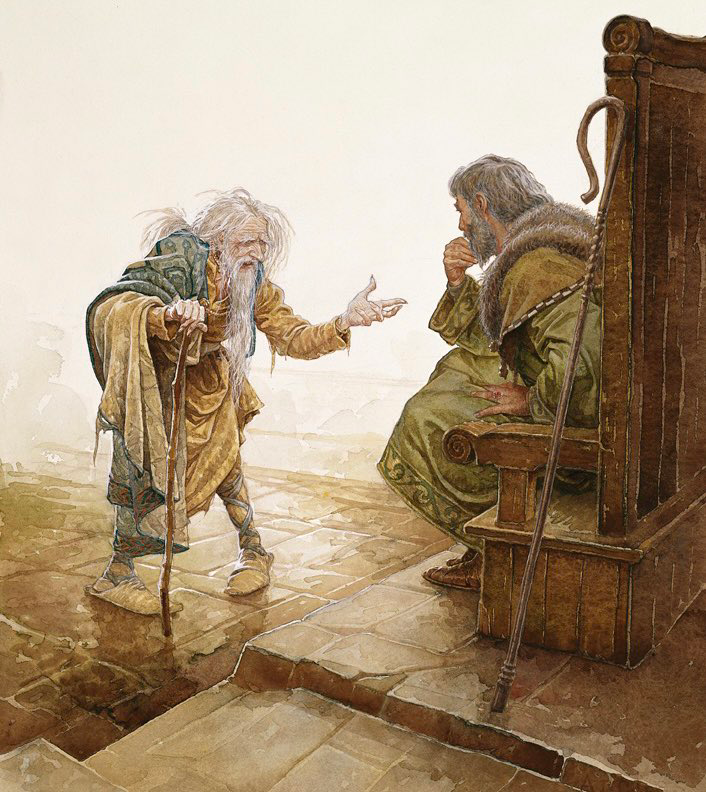
(Image taken from PJ Lynch: Oisín and St. Patrick)
And so this story remained forever — a metaphor for the distance between the human and the mythical, for the desire to stay young, and for the inevitability of time, which not even enchanted lands can halt. Oisín returned and found transformation and silence, for the time of men waits for no one; neither heroes nor lovers are spared from its march.
Peter Pan, by contrast, survives as a symbol: not because he conquers physical time, but because he embodies the refusal to let the soul grow old. Between the Celtic hero and the flying boy, a mirror opens that challenges us — the first shows us that the body is fragile and succumbs to the passage of time, the second reminds us that the spirit can suspend gravity, fly, and endure where the body fails. There is, therefore, no true eternity outside of stories: there is only the choice of how we inhabit the time we are given, whether we live it merely as a succession of days or dare to extend within it the spark of enchantment. Perhaps therein lies the only possible youth: not one that defies death, but one that is renewed whenever we allow ourselves to believe.
And, of course… a little fairy dust…


Comentários