Natal em copos cheios/Christmas in Brimming Glasses
- luaemp
- 21 de dez. de 2025
- 7 min de leitura
(Followed by the English version)
Já falamos de cânticos, de palavras, é talvez tempo de mergulharmos em algo menos etéreo…
Há muitas luas atrás, já vos falei dos pratos típicos irlandeses servidos na ceia e no dia de Natal… — É fácil recordar: desde que um irlandês tenha batatas e manteiga está tudo bem…
Este ano, resolvi explanar sobre bebidas — não há uma bebida única típica do Natal, mas sim um conjunto de bebidas que ganham destaque nesta época fria, festiva e de convívio.
Começo com o Mulled wine — vinho aquecido e aromatizado com especiarias — talvez aquele que não pode faltar na festa.
Não é uma bebida criada pelos irlandeses: é uma tradição que atravessa milénios e continentes. Já na Antiguidade, os gregos e romanos o aqueciam com mel, pimenta e ervas para criar bebidas que aquecessem ou servissem para fins medicinais. Em festivais romanos, como a Saturnalia, no solstício de Inverno, deram-lhe o nome — estranhamente apropriado — de conditum paradoxum.
O verbo mull, no sentido de aquecer, adoçar e aromatizar bebidas com especiarias, aparece em inglês já no início do século XVII. O seu primeiro registo conhecido data de 1618, segundo o dicionário Merriam‑Webster, e deve ser distinguido do uso moderno de mull (‘ponderar’), surgido apenas no século XIX.
Curiosamente, é precisamente nesse século que o mulled wine se transforma de simples bebida quente em símbolo natalício. As feiras de Natal da Europa Central começaram então a difundir a tradição, cada vendedor apresentando a sua própria receita. Daí espalhou-se rapidamente por outras regiões da Europa e chegou também às Ilhas Britânicas. O Reino Unido, com criações como o Smoking Bishop — uma variação de vinho aquecido com fruta e especiarias, popular na era vitoriana e imortalizada por Charles Dickens em A Christmas Carol — pode ter contribuído, e muito, para a consolidação desta tradição.
Tinha e tem tudo para dar certo: a combinação do vinho quente e especiarias evoca imediatamente calor e convívio em noites de Inverno. Além de que o Mulled wine permite utilizar vinhos menos caros pois passa despercebido com o mel, especiarias e o aquecimento.
A transição de tradições pagãs (solstício) para o seio das celebrações cristãs foi pacífica e neste caso muito bem-vinda.
Segue-se o hot whiskey, (ou “hot toddy” na versão irlandesa). Uma mistura simples de whiskey, água quente, mel, limão e cravinhos espetados — o remédio caseiro que aquece o corpo e consola a alma.
A sua origem é algo difusa: uma das teorias aponta para a Índia, onde uma bebida fermentada feita da seiva de palmeira deu o nome toddy. Outra versão situa o seu surgimento na Escócia do século XVIII, quando se começou a servir whiskey aquecido com água nos pubs, tradição que atravessou o mar e ganhou forma definitiva na Irlanda. Por terras irlandesas, médicos como Robert Bentley Todd chegaram a prescrevê-lo — the ‘Potion de Todd’ — contra febres e constipações, mas cedo a receita passou da botica para o pub, onde aquece e conforta há gerações, especialmente nas noites frias de Natal.
Uma outra bebida, nascida e criada aqui na Irlanda é o famoso Baileys Irish Cream criado em 1973, em Dublin, pela empresa Gilbeys of Ireland. A ideia partiu de um grupo de executivos (David Dand, Tom Jago e consultores da agência de marketing David Gluckman e Hugh Seymour-Davies), que procuravam uma forma inovadora de promover o whiskey irlandês no mercado internacional. A receita combinou whiskey irlandês, natas frescas e cacau/chocolate, e o resultado foi o primeiro licor de creme estável do mundo — um produto que não talhava com o tempo.
O sucesso foi imediato, e o Baileys tornou-se símbolo global da Irlanda, associado ao conforto, à sobremesa e às festividades — especialmente no Natal, quando é servido puro, com gelo, em café, chocolate quente ou sobremesas.
Hoje, marcas artesanais como Five Farms (produzido no condado de Cork) recuperam o conceito com produtos premium, feitos apenas com natas e whiskey locais, reforçando essa identidade irlandesa.
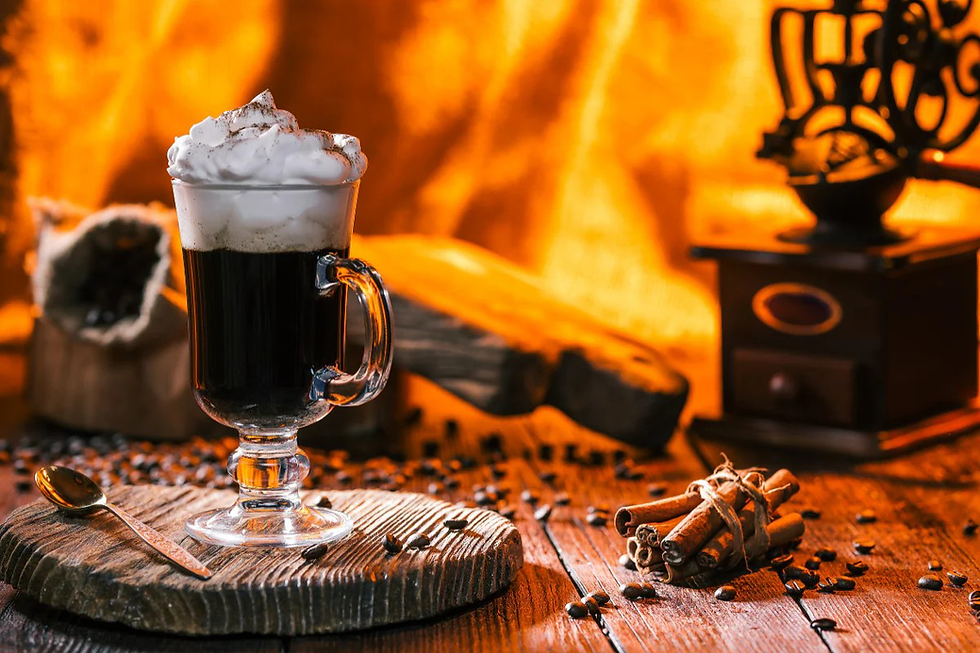
E, finalmente, para acabar o repasto em grande, outra bebida irlandesa de gema, o Irish coffee. Já vos contei a história num outro post, mas cá fica um resumo.
Foi criado em 1943, no aeroporto de Foynes, no condado de Limerick, que então servia como um dos principais centros de voos transatlânticos. O chef e barman Joe Sheridan trabalhava no restaurante do terminal e numa noite fria e ventosa, decidiu preparar algo reconfortante para passageiros que regressavam de um voo muito atribulado. Misturou whiskey irlandês, açúcar, café quente e natas ligeiramente batidas por cima.
Uma passageira americana perguntou se aquilo era café brasileiro, e Sheridan respondeu:
“No, it’s Irish coffee.”
A bebida tornou-se um sucesso imediato. Em 1952, foi apresentada nos Estados Unidos, no Buena Vista Café, em S. Francisco, onde o barman Jack Koeppler e o escritor Stanton Delaplane a popularizaram.
Hoje, o Irish Coffee é um clássico, tanto em bares como em casas irlandesas — especialmente no Natal e inverno, quando combina o calor do café com a força do whiskey e o toque suave das natas.
E assim, entre especiarias, vinho, mel, café, creme e uísque, o Natal irlandês aquece o corpo e a alma — copo a copo, história a história.
English version
We’ve already talked about carols, about words — perhaps it’s time to dive into something a little less ethereal…
Many moons ago, I told you about the typical Irish dishes served at Christmas dinner and on Christmas Day… — easy to remember: as long as an Irish person has potatoes and butter, all is well…
This year, I’ve decided to explore drinks — there isn’t a single Christmas drink in Ireland, but rather a collection of beverages that take centre stage during this cold, festive, and sociable season.
Let’s start with mulled wine — heated and spiced wine — perhaps the one drink that simply cannot be missing from the festivities.
It wasn’t invented by the Irish: it’s a tradition that spans millennia and continents. Back in Antiquity, the Greeks and Romans heated it with honey, pepper, and herbs to create drinks that warmed the body or served medicinal purposes. At Roman festivals like Saturnalia, held at the Winter solstice, it was given the strangely fitting name conditum paradoxum.
The verb mull, in the sense of heating, sweetening, and spicing a drink, appears in English as early as the beginning of the 17th century. Its first known record dates back to 1618, according to the Merriam‑Webster dictionary, and it should be distinguished from the modern use of mull (‘to ponder’), which only emerged in the 19th century.
Interestingly, it was precisely in that century that mulled wine transformed from a simple warm drink into a Christmas symbol. Central European Christmas markets began spreading the tradition, with each vendor offering their own recipe. From there, it quickly spread to other regions of Europe and eventually reached the British Isles. The United Kingdom, with creations like the Smoking Bishop — a variation of heated wine with fruit and spices, popular in the Victorian era and immortalized by Charles Dickens in A Christmas Carol — may have played a significant role in consolidating this tradition.
It was and still is a winning combination: the blend of warm wine and spices instantly evokes warmth and conviviality on winter nights. Moreover, mulled wine allows the use of less expensive wines, as the honey, spices, and heating mask any shortcomings.
The transition from pagan traditions (the solstice) to the heart of Christian celebrations was peaceful, and in this case, very welcome.
Next comes hot whiskey (or “hot toddy” in its Irish version). A simple mix of whiskey, hot water, honey, lemon, and studded cloves — a homemade remedy that warms the body and soothes the soul.
Its origins are somewhat unclear: one theory points to India, where a fermented drink made from palm sap gave the name “toddy.” Another version places its beginnings in 18th-century Scotland, where whiskey heated with water started being served in pubs — a tradition that crossed the sea and took firm root in Ireland. On Irish soil, physicians such as Robert Bentley Todd even prescribed it — the “Potion de Todd” — for fevers and colds, but soon the recipe moved from the pharmacy to the pub, where it has been warming and comforting people for generations, especially on cold Christmas nights.
Another drink, born and created here in Ireland, is the famous Baileys Irish Cream, launched in 1973 in Dublin by the company Gilbeys of Ireland. The idea came from a group of executives (David Dand, Tom Jago, and marketing consultants David Gluckman and Hugh Seymour-Davies), who were looking for an innovative way to promote Irish whiskey on the international market. The recipe combined Irish whiskey, fresh cream, and cocoa/chocolate, resulting in the world’s first stable cream liqueur — a product that wouldn’t curdle over time.
The success was immediate, and Baileys quickly became a global symbol of Ireland, associated with comfort, dessert, and festivities — especially at Christmas, when it is served neat, over ice, in coffee, hot chocolate, or desserts.
Today, artisan brands like Five Farms (produced in County Cork) are reviving the concept with premium products made solely from local cream and whiskey, reinforcing that distinctly Irish identity.
And finally, to round off the feast in style, another quintessential Irish drink: Irish coffee. I’ve already shared its story in another post, but here’s a brief recap.
It was created in 1943 at Foynes Airport, in County Limerick, which at the time served as one of the main hubs for transatlantic flights. Chef and bartender Joe Sheridan worked in the terminal’s restaurant and, on a cold and windy night, decided to prepare something comforting for passengers returning from a particularly rough flight. He mixed Irish whiskey, sugar, hot coffee, and lightly whipped cream on top.
An American passenger asked if it was Brazilian coffee, to which Sheridan replied:
“No, it’s Irish coffee.”
The drink was an immediate hit. In 1952, it was introduced to the United States at the Buena Vista Café in San Francisco, where bartender Jack Koeppler and writer Stanton Delaplane helped popularize it.
Today, Irish Coffee is a classic, enjoyed both in bars and in Irish homes — especially at Christmas and during the winter months, when it combines the warmth of coffee with the strength of whiskey and the smooth touch of cream.
And so, amid spices, wine, honey, coffee, cream, and whiskey, the Irish Christmas warms body and soul — glass by glass, story by story.


Comentários